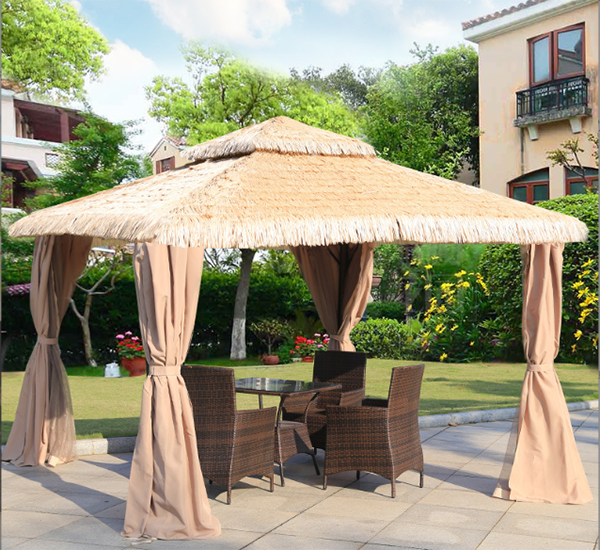
Whether the straw on the straw pavilion will fly away requires a comprehensive judgment based on the following factors:
1. Natural factors
Wind intensity: Strong winds (such as typhoons and hurricanes) may directly scatter unsecured or loosely structured straw, especially at the edges. Ordinary gusts of wind are usually not enough to cause large-scale scattering, but may cause some straw to curl or fall off.
Weather conditions: rainstorm may make straw absorb water and increase weight, reducing the risk of flying, but long-term humidity will lead to decay, indirectly affecting the structural stability; In dry weather, straw is lighter and more brittle, and if not fixed, it is easily blown by the wind.
2. Structure and fixing method
Fixed process: If the straw is woven, tied, or tightly fixed with brackets (such as wooden strips or iron wires), the risk of scattering is significantly reduced. For example, traditional thatched roofs are often reinforced with multiple layers of overlapping and ropes.
Structural integrity: If the overall design of the pavilion (such as slope and load-bearing capacity) is reasonable, it can reduce local shedding caused by uneven stress on straw.
3. Maintenance and aging
Regular inspection: Straw exposed for a long time may become loose due to UV radiation, insect infestation, or decay, and needs to be repaired or replaced regularly.
Material quality: Fresh and dry straw is more resistant to weathering and has a lower probability of scattering compared to old or damp straw.
4. Environmental factors
Geographical location: Pavilions in open areas (such as fields and mountaintops) are more affected by wind; Areas with obstructions such as trees and buildings are relatively safe.
Seasonal changes: Strong winter winds or sandstorms in spring may increase the risk of scattering and require early reinforcement.
Conclusion:
Under normal weather conditions, if the structure of the straw pavilion is stable, well fixed, and regularly maintained, the possibility of straw flying away is low. However, in extreme weather (such as strong wind, rainstorm) or long-term lack of maintenance, some straw may fall off or be blown away. It is recommended to choose weather resistant materials (such as anti-corrosion treated straw) or combine them with modern reinforcement techniques (such as metal mesh covering) to enhance wind resistance.