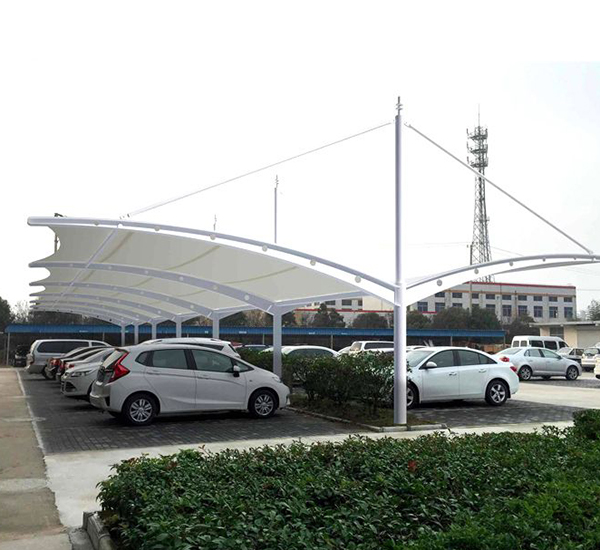
Membrane structure carports have excellent wind and earthquake resistance performance, and their design principles and material characteristics together constitute a powerful protective system. The specific advantages are as follows:
Wind resistance performance: structurally stable, adaptable to extreme weather conditions
Structural stability
The membrane structure carport is supported by steel structures and combined with high-strength membrane materials (such as PVDF, PTFE). The main columns are usually made of 220mm steel pipes or I-beams, and the bottom of the columns is firmly welded to the embedded parts through 10mm thick steel plates. The embedded parts are fixed by pouring concrete. This design enables the carport to withstand typhoons of level 12 or above, and even maintain stability in areas with strong winds.
Flexible adaptation to wind force
The flexibility of the membrane material enables it to disperse wind force through slight deformation, avoiding local stress concentration. For example, PVDF membrane structure carports can usually withstand wind speeds of 8-10 levels, are not easily collapsed in snowy weather, the membrane material is not easily faded, and can maintain stable performance even after long-term use.
Optimization of Drainage Design
The tensioning structure naturally forms a drainage slope, allowing rainwater to quickly drain away from the roof, reducing the pressure of accumulated water on the structure and further enhancing its wind resistance.
Seismic performance: lightweight and high-strength, energy dispersion
Lightweight structure reduces harm
The overall weight of membrane structure carports is only 1/10 to 1/30 of traditional metal carports. During earthquakes, the inertia force is small and it is not easy to collapse or fall off due to severe vibrations. The supporting body is a high-frequency welded steel structure, and the shear stress transmitted by earthquakes can cause local bending of the steel structure at most. The membrane material is fixed by a special tension membrane plate on multiple sides, and even if torn, it will not fall off, avoiding secondary damage.
Pre stressing tensioning technology enhances stability
There is a stress field inside the membrane material, which results in a certain degree of stiffness. Under high stress conditions, the higher the tensile strength, the less likely it is to age. The safety factor under long-term load is usually taken as 6-8, and under short-term load, it is taken as 4 to ensure the stability of the structure in earthquakes.
Design theory ensures seismic resistance
The membrane structure carport is completed through four steps: body design, initial balance design, load analysis, and cutting analysis. There is no stress free state at any time, and cutting needs to be completed under precise structural deformation and stress combination, creating extremely strong seismic performance. The general seismic design level is above level 8. In the event of a general earthquake, people can use membrane structure buildings for shock absorption without worrying about objects falling off their heads.
The underlying logic of performance advantage
Material Properties
The membrane material contains high-quality flame retardant and high temperature resistant components, and the fire protection index is up to the standard. At the same time, it has high strength and aging resistance. Steel structure support provides a rigid foundation, and the combination of the two achieves a balance of rigidity and flexibility.
structural innovation
Pre stressing tensioning technology enables the membrane material to maintain tension and disperse loads under stress; The combination of steel structure and steel cable enhances overall stability and avoids local instability.
Design optimization
Through precise load analysis and cutting design, the membrane structure carport can adapt to different environmental requirements, such as strong winds, earthquakes, and other extreme conditions, ensuring long-term safe use.